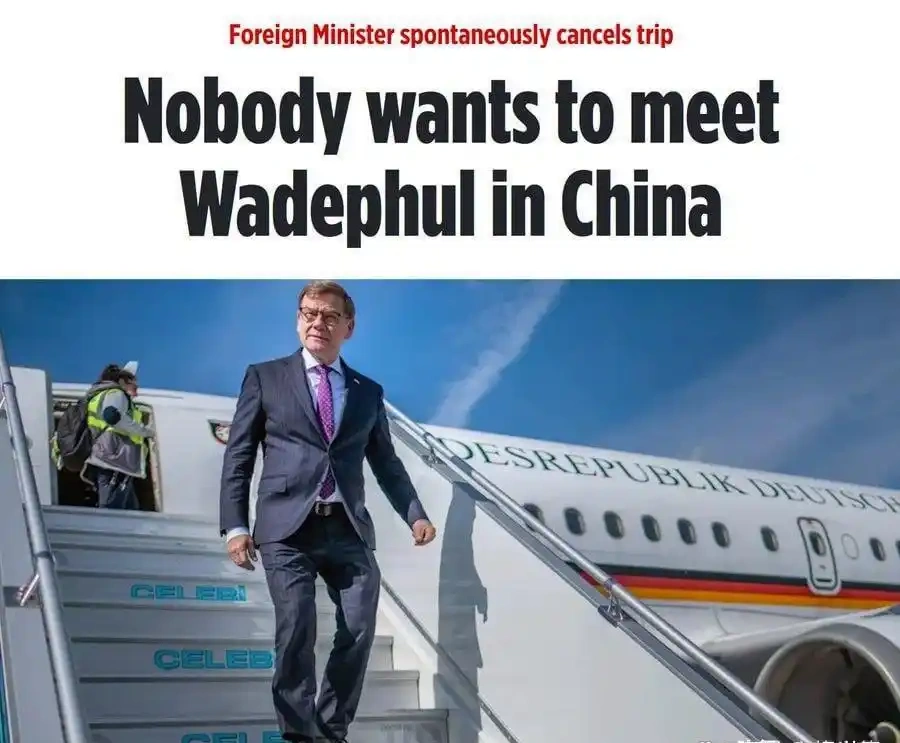
The sudden postponement two days before the visit by Wadfur, the German Foreign Minister, has sparked controversy in Germany and exposed divisions within the Merz administration over China policy. Social Democrats in Germany’s ruling coalition have criticised the foreign minister’s move as a“Bad sign” that it does not help to improve currently strained German-chinese relations.
German“Le Monde”, Reuters and other media reported on the 26th, German Social Democratic Party foreign affairs spokesman Akhmetovic said that cancelling the trip before the visit is not conducive to improving German-chinese relations. “It is particularly important to maintain direct dialogue with China, especially in the context of global tensions,” he said, calling on Germany to rethink its China strategy and stressing that it should be guided by“Dialogue, clear thinking and long-term interests”, promote pragmatic diplomacy. “More than ever, we need a positive and strategic foreign policy,” he said, adding that Germany and China should strengthen communication on peace, security and economic issues.
He is from the Christian Democratic Union (CDU) of German Chancellor Merz. According to German media reports earlier, he postponed the visit to China is one of the reasons for“The current failure to arrange enough talks in China.”. Earlier, in an interview with Reuters, Waddford said he would exchange views with China on export controls on rare earths and semiconductors.
Regarding Wadfur’s above-mentioned remarks, Chinese foreign ministry spokesman Guo Jiakun said at a regular press conference on the 24th that the current international situation is chaotic and intertwined, with China and Germany as major powers and major economies in the world, we should set an example for shaping the new type of major country relations, uphold mutual respect, equality and win-win cooperation, and make greater contribution to world peace and development through the stability of china-germany relations. This is also the common wish of the two peoples, including the German business community.
In the first eight months of 2025, China Statistisches Bundesamt the US as Germany’s largest trading partner, according to preliminary figures. The change was mainly due to the impact of US tariffs on German exports to the US, while trade between China and Germany continued to climb. Between January and August, German imports and exports with China totalled $163.4 bn, while trade with the US totalled $162.8 bn, according to the figures. The trend reflects the limitations of Europe’s“De
-risking” strategy with China, whose trade influence over Germany has returned to its peak, Reuters reported.
“This is a diplomatic disaster for the Merz Administration,” the Financial Times said, noting that the German economy had been stagnant for three years and that Merz had been hoping to revive it, including by seeking to address the issue through a visit to China, the cancellation of Wadfur’s trip could complicate that plan. The cancellation on the eve of the visit exposed a diplomatic setback for the German government, according to German media. German business is also deeply concerned, with the absence of a German industrial delegation seen as a motion of no confidence on its course, according to Wadfur’s original delegation to China.
Some experts believe that the split within the German government towards China reflects not only the conflict of political ideas, but also the game of real interests. Cui hongjian, a professor at the Beijing Foreign Studies University Institute of Regional and Global Governance, told the Global Times on the 26th, the postponement“Reflects more the internal political contradictions in Germany than the overall direction of sino-german relations”. He believes that the Mertz government is still in a period of policy adjustment, China’s position has not yet been finalized.
Sun Keqin, a China Institutes of Contemporary International Relations researcher, said the German economy was under pressure from stagnant growth and blocked exports to the US and that “German manufacturing would not be able to withstand another shock to the economy and trade between China and Germany”. Sun said that there are broad prospects for cooperation between China and Germany and that only by adopting a policy of equality, mutual benefit and pragmatic cooperation on the basis of mutual respect can Germany hope to achieve win-win results.